- Details
- Category: Sculptures

Tuco was born in the remote back woods of Maryland and was the discard from his litter as he was born with extra toes on his feet. We adopted him in 2006 from a toothless meth addict living in a squalid trailer with a rear projection TV, a satellite dish, and a coffee table full of unemptied ashtrays. When we brought him home we immediately dewormed him, and at the advice of our vet at the time, had his extra digits surgically removed. Unfortunately the procedure must have traumatized him because to this day he does not like anyone touching his paws. We figure Tuco is about 60 in human years as of 2017. The black fur is actually a dark ceramic glaze, same as the one used for my White Tiger. My thanks to the Ceramic Art Studio and Shop.


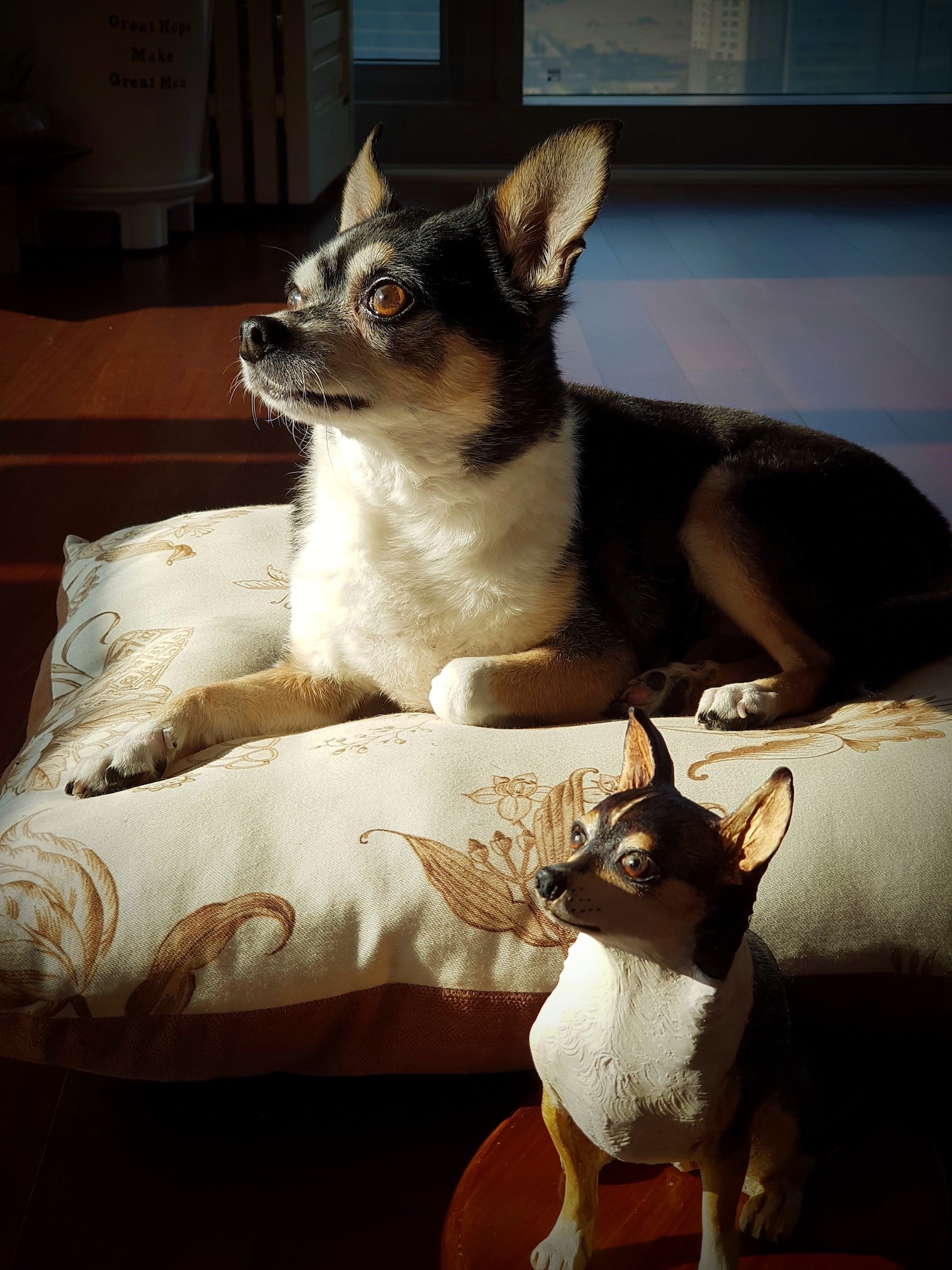
Tuco (Top) and his ceramic tribute (Bottom).

Tuco Wet Clay Model
- Details
- Category: Sculptures

In Greek mythology Atlas was a Titan who was condemned by Zeus to hold up the skies for eternity after the Titanomachy, the war between the Olympian gods and the Titans. In ancient artworks, Atlas often symbolized endurance, eternity, and immensity. The Atlas mountains and the Atlantic Ocean are fittingly named after this Titan. For my model I chose a water bowl with the zodiac constellations to represent the heavens. Atlas crouches above the northern hemisphere, with his right knee atop Asia and his left foot planted firmly on California, symbolizing my cultural footing. Incidentally my first attempt shattered during bisque firing (see version 1.0 below), so the final model is actually a second version. Thanks always to the Ceramic Art Studio and Shop.

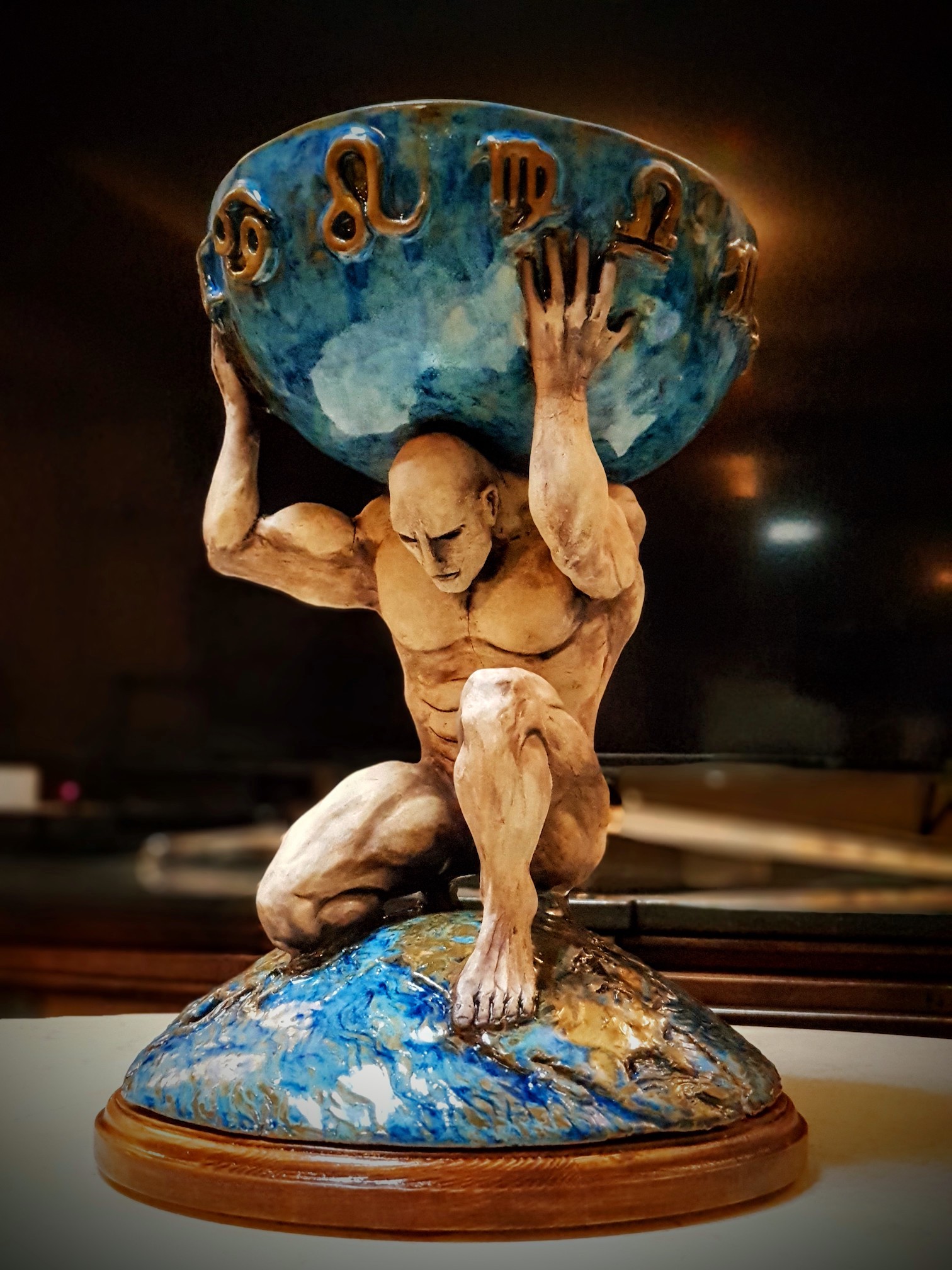


Atlas 2.0 Wet Clay, I improved the sense of weight upon his shoulders and also added all 12 zodiac constellation symbols.

Atlas 1.0 Wet Clay, The left arm and shoulder shattered during bisque firing.

Atlas concept sketch
- Details
- Category: Sculptures
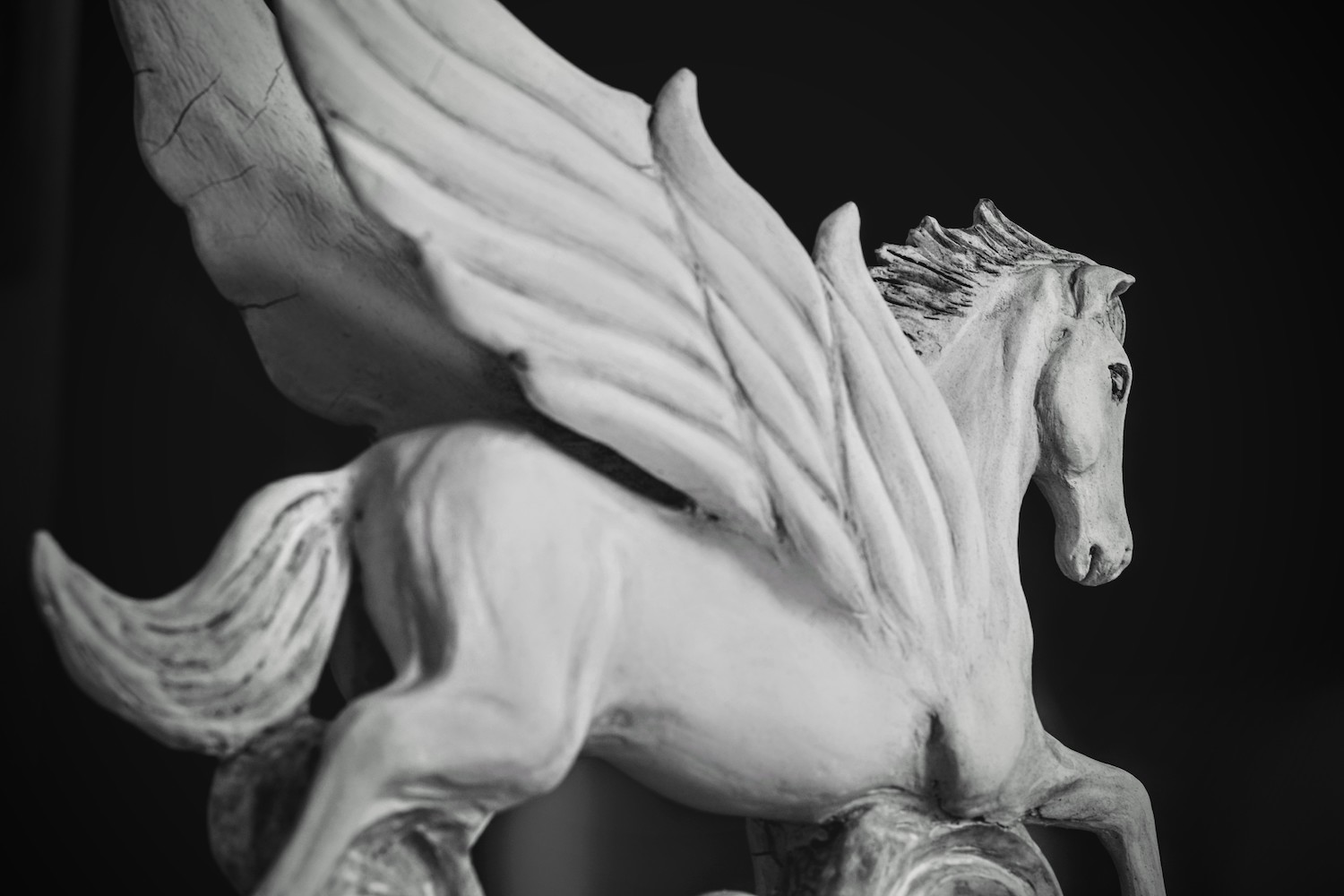
In Greek mythology, Pegasus was sired by Poseidon and sprang from the gorgon Medusa's blood upon being decapitated by Perseus. The loyal Pegasus carried thunderbolts from Olympus to Zeus until he was tamed by Bellerophon and assisted the hero in slaying the Chimera. Like dragons, mythological winged or flying horses are also present in other cultures: Buraq in Islam, Chollima in Korea, Tianma in China, and the steed of the Norse Valkyries. I think the concept of flying horses were naturally to early man what our vision is today for flying cars. Artistically, this majestic creature evokes beauty, strength, and freedom. My first attempt at Pegasus shattered during the bisque firing (see clay version below), so I sculpted a second larger, and I think a much improved version. As always, thanks to the Ceramic Art Studio and Shop, where I am given both guidance and the freedom to explore my creative outlet.


 Pegasus - first version which shattered during bisque firing.
 Concept sketch
- Details
- Category: Sculptures

There are many theories on the origin of the dragon myth, ranging from our primitive ancestors' attempts to explain dinosaur fossils to an amalgam of our earliest natural predators (serpents, raptors, and big cats). Although capable of flight, Asian (Chinese) dragons are primarily associated with water (their serpentine form flowing like rivers and seas). While the description of the Chinese dragon is fairly consistent across sources, their depictions vary considerably depending on the country, era, artist, and genre. There is even meaning behind the number of claws they have per each foot. Ancient dragon symbols have been discovered that date as far back as 6000 BC, but I decided to base my design on one of the earliest "modern" representations available, a 13th century masterpiece handscroll painting by Chen Rong: "Nine Dragons." I kept the morphology consistent with Chen Rong's dragons except the tail. The dragon's pose was stylistically inspired by Jack Kirby. As always, thanks to the Ceramic Art Studio and Shop.


Bisque fired

Wet clay model

Work in progress

Concept sketch
- Details
- Category: Sculptures

Sea turtles are highly adapted marine reptiles that have been around since the age of dinosaurs. These solitary creatures can hold their breath for up to 40 minutes while actively foraging, and up to 7 hours while sleeping. The sea turtle's ability to navigate hundreds of miles back to the exact beach from where they hatched is one of the most remarkable feats in the animal kingdom. This sculpture is based on the green sea turtle, an endangered species with an amazingly beautiful shell pattern that can grow up to 5 feet. Sharks on the other hand, are terrifying predators and one of the main reasons I avoid swimming in the sea. I made this piece as a graduation gift for my son Sean. Thanks always to the Ceramic Art Studio and Shop. (Note: the wooden base in these pics is not the final version - I am working on a larger one that fits better.)


The shell serves as a nice lid.

Bisque fired
 Wet clay model

Concept sketch - very rough; I worked mostly from stock images.
Page 52 of 55
- You are here:
-
Home

- Sculptures